
Can The Economy Outrun The Fed?


Summary
The Fed is expected to raise rates this week, but a repeat of 2022’s hiking cycle is not our base case. In five of the past six hiking cycles, stocks were positive over the following year, underscoring that economic conditions and inflation trends matter more than the direction of rates alone.
The economy continues to expand, and earnings growth has helped bring stock valuations back to their 10-year average. Investors are paying more reasonable prices for growing profits, which helps reduce some risk as the market digests the uncertainty around AI spending and rising oil prices.
Historical market patterns favor additional gains through year-end. Similar first-half recoveries as well as double-digit market gains through August have typically preceded positive finishes, suggesting any near-term weakness would remain consistent with a broader advance.
Our microcast™ signal remains at a neutral allocation. Taken together, our tactical risk models continue to indicate a constructive backdrop for equities.
THE FED IS EXPECTED TO RAISE RATES AS INFLATION REMAINS ELEVATED
The Fed is expected to raise interest rates by 0.25% this week. Inflation remains a concern, but the economy is strong enough to give policymakers room to act. This would be the first increase to the federal funds rate since July 2023.
The start of a Fed hiking cycle is not, by itself, a reason to turn bearish on stocks. Over the past 30 years, stocks were higher one year after the first rate hike in five of the six previous Fed hiking cycles. Market performance was often weak in the first one to three months, but 2022 was the only cycle in which the market finished lower a year later (data from LPL):

The 2022 hiking cycle reflected an unusual set of circumstances. Pandemic-driven supply disruptions collided with strong consumer demand, fueled by three major fiscal stimulus packages and the reopening of the global economy, which drove inflation to its highest level in four decades. The Fed was slow to respond and ultimately had to tighten aggressively to catch up.
We think today’s backdrop is fundamentally different. While the recent uptick in inflation is a legitimate concern, it remains well below the levels reached before the Fed began hiking rates in March 2022. Policymakers today aren’t confronting the same combination of supply shocks, extraordinary fiscal stimulus, and delayed policy response that defined 2021-2022.
Ultimately, what matters for the market is how tighter policy affects economic growth, corporate earnings, and liquidity. As the historical record above shows, a rate hike is not inherently negative. The key question is whether tighter financial conditions materially weaken the economic and earnings outlook. For now, that backdrop remains strong.
THE ECONOMY REMAINS RESILIENT, AND CORPORATE EARNINGS ARE STRONG
The US economy remains stronger than the prevailing narrative suggests. Unemployment is still low, while current estimates point to roughly 4.4% annualized GDP growth in the third quarter. That underlying strength gives the Fed more room to raise rates without immediately threatening the economic expansion (data from the Atlanta Fed):

As we’ve discussed in previous issues of Market Musings, investment in artificial intelligence has become an important contributor to economic growth. That makes last week’s warnings from leaders at Anthropic, OpenAI, and Google, as well as Elon Musk, to pause or slow the development of frontier models economically relevant, not just technologically significant.
The key question is whether those warnings lead to a meaningful slowdown in AI-related capital spending. If they do, one of the economy’s strongest sources of incremental investment could weaken. For now, however, the effect on growth and corporate earnings is still too uncertain to quantify.
The good news is that strong earnings growth has made valuations more reasonable. The S&P 500 now trades at 19.1 times forward earnings, roughly in line with its 10-year average and below its five-year average of 19.9 times (chart from DataTrek):

That matters because investors are paying less for each dollar of expected earnings than they were through much of 2024 and 2025, even as both the economy and earnings outlook remains constructive. The market is not “cheap,” but valuations are no longer as demanding. That gives the market more room to absorb higher rates, uncertainty around AI investment, and volatility in oil prices without requiring a meaningful reset in prices
MARKET HISTORY SUPPORTS A STRONG FINISH TO THE YEAR
History also supports a constructive outlook for the remainder of the year. Since 1950, there have been six prior instances when the S&P 500 followed a negative first quarter with a second-quarter gain of more than 10%, as it did this year. In every case, stocks went on to post gains in both the third and fourth quarters, with an average second-half return of 15%. With two weeks remaining in the third quarter, the S&P 500 is up 2.3% through September 11, 2026 (table from Stock Trader’s Almanac):

In addition, when the S&P 500 gained between 10% and 20% through August, stocks finished higher in the final four months in 18 of 20 cases, with an average gain of 6%. Performance in September and October was mostly a coin flip, with much of the strength arriving in November and December (table from 3Fourteen):
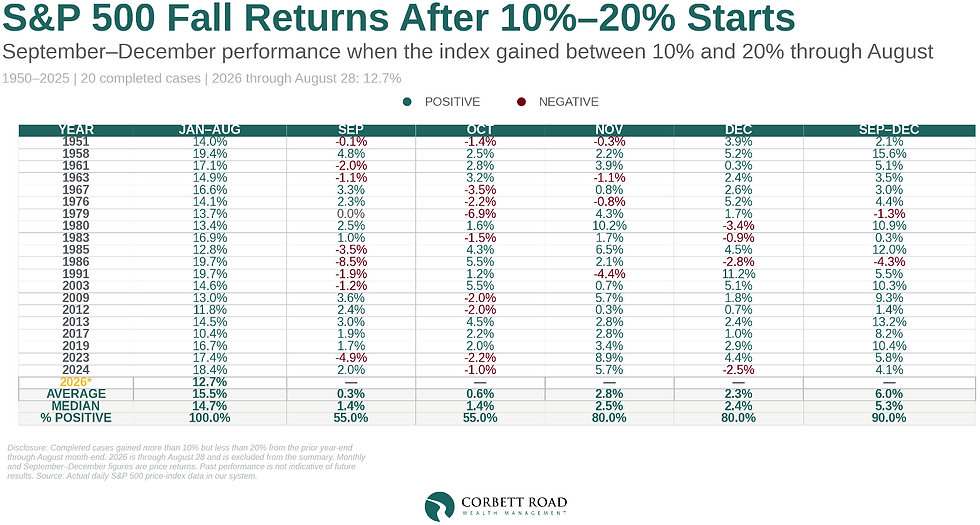
These historical patterns do not determine how the year will finish, but they reinforce a constructive outlook. Near-term volatility would be entirely consistent with prior cycles and, on its own, would not change the broader investment case.
In summary, an expected Fed rate hike this week may evoke memories of 2022, but today’s backdrop is fundamentally different. Economic growth remains healthy, inflation is rising at a much slower pace, corporate profits continue to grow, and valuations are less demanding than they were at the start of the year. History also suggests that the market can continue to advance through a tightening cycle, even if the path over the next several weeks is uneven.

Important Disclosures
The chart(s)/graph(s) shown is(are) for informational purposes only and should not be considered as an offer to buy, solicitation to sell, or recommendation to engage in any transaction or strategy. Past performance may not be indicative of future results. While the sources of information, including any forward-looking statements and estimates, included in this (these) chart(s)/graph(s) was deemed reliable, Corbett Road Wealth Management (CRWM), Spire Wealth Management LLC, Spire Securities LLC and its affiliates do not guarantee its accuracy.
The views and opinions expressed in this article are those of the authors as of the date of this publication, are subject to change without notice, and do not necessarily reflect the opinions of Spire Wealth Management LLC, Spire Securities LLC or its affiliates.
All information is based on sources deemed reliable, but no warranty or guarantee is made as to its accuracy or completeness. macrocast™ and microcast™ are proprietary indexes used by Corbett Road Wealth Management to help assist in the investment decision-making process. Neither the information provided by macrocast™ or microcast™ nor any opinion expressed herein considers any investor’s individual circumstances nor should it be treated as personalized advice. Individual investors should consult with a financial professional before engaging in any transaction or strategy. The phrase “the market” refers to the S&P 500 Total Return Index unless otherwise stated. The phrase “risk assets” refers to equities, REITs, high yield bonds, and other high volatility securities.
Corbett Road’s quantitative models utilize a variety of factors to analyze trends in economic conditions and the stock market to determine asset and sector allocations that help us gauge market movements in the short- and intermediate term. There is no guarantee that these models or any of the factors used by these models will result in favorable performance returns.
Individual stocks are shown to illustrate market trends and are not included as securities owned by CRWM. Any names held by CRWM is coincidental. To be considered for investment by CRWM, a security must pass the Firm’s fundamental review process, meet certain internal guidelines, and fit within the parameters of the Firm’s quantitative models.
Spire Wealth Management, LLC is a Federally Registered Investment Advisory Firm. Securities offered through an affiliated company, Spire Securities, LLC, a Registered Broker/Dealer and member FINRA/SIPC. Registration does not imply any level of skill or training.