
July 2026

BUSINESSES THAT BUILT AMERICA
As America celebrates its 250th birthday, here’s a look at a few American companies that were founded before the Declaration of Independence was signed in 1776. These remarkably resilient businesses helped build and support the new nation and have been operating continuously ever since. So if you want to read a newspaper that reported on the Boston Tea Party, buy a shovel from the manufacturer that supplied them to Revolutionary War soldiers, or even sample George Washington’s signature scent from the company that produced it, you can.

Source: Business News Daily, 2026; Oldest.org, 2026
PHASED RETIREMENT CAN HELP SMOOTH THE TRANSITION
Two-thirds of Gen X and 56% of millennials would prefer to gradually decrease their hours or work a more flexible schedule as they transition to retirement. About half of baby boomers and Gen Z have similar preferences.1
The federal government has offered a formal phased retirement program since 2014, allowing eligible full-time employees to collect half their pensions while working half time. Typically, at least 20% of their remaining work hours must be spent mentoring younger workers. And their pensions continue to grow based on part-time work.2
Private industry has been slower to adopt formal programs. Only 16% of employers, mostly larger companies, have regular phased retirement programs. However, 61% of companies have some experience with phased retirement, and with strong employee interest, it’s likely that more will adopt formal programs.3
Win-win-win solution
A phased retirement program can be a positive experience for employees, employers, and customers.
For older employees, a reduced schedule offers a more gradual financial transition, maintaining a steady, if reduced, income that can help delay taking Social Security benefits and/or tapping retirement savings. Trying to live on 80% of salary, for example, might also be good practice for retirement budget management. And staying engaged in the workplace can offer mental and psychological benefits.
For employers, older workers provide experience and institutional knowledge that can help maintain and improve current quality while mentoring younger workers to help ensure a smoother transition.
For customers, older workers can provide dependability and continuity. In some cases, customers are also older, and long-time relationships can help maintain customer comfort levels.
Build your own program
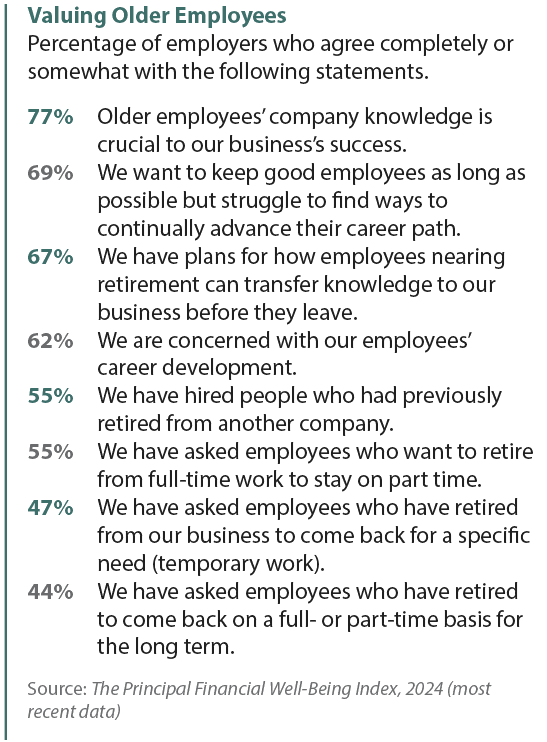
If your company does not offer such a program, you might suggest an arrangement. Emphasize what you can continue to contribute and how it could help the company in the present and the future. But also be sure that the program will work for you. Here are some ideas to keep in mind.
Make sure you understand the effect of reduced hours on your benefits, such as health insurance and employer pension or retirement plan contributions.
If you cannot live on your reduced wages, you may have to use other sources of income, but you probably would not have to tap them as much as if you retired completely.
One of the greatest benefits of phased retirement is that you could delay claiming Social Security, with your benefit increasing 8% annually after full retirement age (FRA), up to age 70. However, if you do claim Social Security before FRA and continue to work, you will receive a permanently reduced benefit for claiming early and be subject to the retirement earnings test, which may temporarily reduce your benefit payments until you reach FRA. Once you have reached FRA, the lost benefits from the earnings test will be added to your benefit amount.
If you phase out of your current job, make sure you don’t end up trying to do all of your former work in fewer hours. This could be especially problematic for salaried workers in project-oriented positions. Be sure you and your supervisor are clear on the requirements of your reduced workload.
1): Kiplinger, January 7, 2026
2): U.S. Office of Personnel Management, August 7, 2014
3): Fortune, March 22, 2024 (most recent data)
TRAVEL TIPS FOR GLOBETROTTERS
About 76% of Americans surveyed by Pew Research Center said they have traveled outside of the United States at least once; 50% have visited one to four countries, while 26% have been to five or more. Nearly one-fourth of respondents (23%) have never traveled internationally.1
If you’re planning a foreign vacation, here are some suggestions to help keep your trip on track.
Obtain required documents. A passport (or in some cases a passport card) is required to enter and return from all foreign countries, including Canada and Mexico. Your passport should have at least six months of validity beyond the dates of your trip. It can take several months to obtain or renew a passport, so procrastinating on this task could put you in a serious bind and/or force you to pay costly rush fees. U.S. citizens can travel to many foreign countries without obtaining a visa, but be sure to follow the rules for all countries on your itinerary. Some countries require travelers to complete an electronic pre-screening process prior to entry.
Alert your bank and credit card company. Financial institutions monitor international transactions, so it’s wise to inform them that you will be traveling and ask about applicable fees. Carry at least two cards: a debit card that will allow you to withdraw money from foreign ATMs and a chip-enhanced credit card with a PIN set up before you leave. Although the credit card may only require a signature in the United States, it might require a PIN overseas.
Pay like a local. Know the exchange rate to convert dollars to local currency, and vice versa. Foreign bank ATMs may offer better exchange rates than a currency exchange, but be aware of fees wherever you exchange money. Merchants, restaurants, and hotels might accept payment or quote prices in U.S. dollars, but you will typically get a better price if you pay in the local currency, whether using cash or a credit card.
Consider your health needs and coverage. Some countries may recommend, or in some cases require, vaccinations for diseases that are rare in the United States (such as typhoid, yellow fever, and polio). To help protect your health and your finances, you should be aware of the public health situation in any country you visit and determine whether your medical insurance will cover you overseas. If not, consider purchasing a short-term travel policy. Bring enough prescription medicine, plus extras, in original labeled containers in your carry-on luggage. A note from your doctor listing medications may be helpful.
For in-depth information on foreign travel, including passports and visas, visit travel.state.gov. For health guidelines and country-specific public health information, see cdc.gov/travel.
1) Pew Research Center, December 6, 2023 (percentages rounded to the nearest whole number)
IS IT TIME TO DECLARE YOUR FINANCIAL INDEPENDENCE?
No matter how much money you have or which life stage you’re in, becoming financially independent starts with a dream. Maybe you want to finally pay off the mountain of debt you’ve accumulated or stop relying on someone else for financial support. Or perhaps your dream is to retire early so you can spend more time with your family, travel the world, or open your own business. Financial independence, however you define it, is freedom from the financial obstacles that are keeping you from living life on your own terms.
Envision the future
If you were to become financially independent, what would change? Would you spend your time differently? Live in another place? What would you own? Would you work part time? Ultimately, it’s up to you to define the life you want to live. It’s your dream, so there’s no wrong answer.
Work at it
Unless you’re already wealthy, you may have had moments when winning the lottery seemed like the only way to become financially secure. But your path to financial independence isn’t likely to start at the lottery counter of your local convenience store.
Though there are many ways to become financially independent, most of them require hard work. And retaining wealth isn’t necessarily easy, because wealth may not last if spending isn’t kept in check. As income rises, lifestyle inflation could slow, or even reverse, your progress. Becoming — and remaining — financially independent requires diligently balancing earning, spending, and saving.
Earn more. No matter which goals you’re pursuing, the wider the gap between your income and expenses, the shorter the path to financial independence. The more you can earn, the more you can potentially save. This might mean finding a job with a higher salary, working an extra job, or working part time in retirement. And a job is just one source of income. If you’re resourceful and able to put in extra hours, you may also be able to generate regular income in other ways — for example, renting out a garage apartment or starting a side business.

Spend wisely. Look for opportunities to reduce your spending without affecting your quality of life. For the biggest impact, focus on reducing your largest expenses, such as housing, food, and transportation. Practicing mindful spending can also help you free up more money to save. Before you buy something nonessential, think about how important it is to you and what value it brings to your life so that you don’t end up with a garage, attic, or storage unit filled with regrettable purchases.
Save aggressively. Set a wealth accumulation goal and then prioritize saving. Of course, if you have a substantial amount of debt, saving may be somewhat curtailed until that debt is paid off. Take simple steps such as choosing investments that match your goals and time frame, and paying yourself first by automatically investing as much as possible in a retirement savings plan.
Keep going
Life changes. Unexpected bills come up. Some years will be tougher financially than others. Expect to make some adjustments to your plan along the way, especially if you have a long-term time frame, but keep going.
Finally, make sure to celebrate both small milestones and big victories. Seeing the progress you’re making can help you stay motivated as you pursue your dream of financial independence.
UNDERSTANDING THE "NO TAX ON TIPS" DEDUCTION
If you’re one of the estimated six million taxpayers working in a job where you receive tips, you may be interested in learning more about the new “no tax on tips” deduction.1
In 2025, the One Big Beautiful Bill Act established a temporary federal tax deduction to help reduce the tax liability of certain tipped workers for tax years 2025-2028. Employees and self-employed taxpayers may deduct up to $25,000 annually in qualified tips as long as they work in an occupation the IRS views as “customarily and regularly” receiving tips. Qualified tips include voluntary cash tips and amounts paid by credit or debit card, including amounts received through tip-sharing arrangements. Automatic gratuities and mandatory service charges do not qualify.
The deduction is available whether the taxpayer claims the standard deduction or itemizes deductions. Self-employed individuals cannot claim a deduction exceeding the net income from the business in which the tips were earned.

Taxpayers who have a valid Social Security number and work in an eligible occupation, such as bartenders, waitstaff, casino dealers, hairdressers, valet attendants, taxi/rideshare drivers, baggage porters, and food delivery personnel, qualify for the deduction. Married couples must file a joint return, while couples filing separately are not eligible. Employers must report all their employees’ tip income to the IRS or Social Security Administration. A complete list of the 68 occupations across eight industries that qualify for the deduction is available at irs.gov.
The deduction begins to phase out for single filers with modified adjusted gross income (MAGI) over $150,000 or over $300,000 for married couples filing jointly. The deduction is reduced by $100 for every $1,000 above these thresholds.
In 2025, the IRS permitted taxpayers to use Form W-2 (Box 7), employer tip reports, Form 4137, and personal tip logs to report qualified tips. In 2026, taxpayers claiming the deduction will use Schedule 1-A, while employers will be required to separately report qualified tips on Forms W-2 and certain 1099s.
Each state will decide whether to adopt, modify, or reject the provision, so taxpayers should check with their state tax agency to determine the tax treatment of tip income.
1) IRS.gov, November 21, 2025
THE EMPLOYMENT SITUATION: A CLOSELY WATCHED REPORT
Among all the economic indicators released each month, the Employment Situation is one of the most watched. Each monthly report is highly anticipated and can move the markets.
What is the Employment Situation?
Each month, the Bureau of Labor Statistics (BLS) publishes the Employment Situation Summary (commonly known as the “jobs report”) based on information from the prior month. The data for the report is derived primarily from two sources: (1) a survey of approximately 60,000 households, or about 110,000 individuals (household survey), and (2) an establishment survey of over 650,000 worksites. The information contained in each report includes the total number of employed and unemployed people, the unemployment rate, the number of people working full time or part time, average hourly and weekly earnings, and average hours worked per week. The report on private payroll excludes government workers. Because it is released by the BLS on the first Friday of every month, it provides the first comprehensive status check of the U.S. economy for the preceding month.
What should you look for within the report?
There’s plenty of important data within each report. The labor force includes all people age 16 and older who are classified as either employed or unemployed. Conceptually, the labor force level is the number of people who are either working or actively looking for work. The unemployed includes people who are not employed as of the date of the particular survey, are available for work, and made an unsuccessful attempt to find a job within the four weeks preceding the date of the survey. The unemployment rate represents the number of unemployed people as a percentage of the labor force. The information contained in this report can have an impact on the stock market as it relates to interest rate expectations, consumer spending, and corporate earnings.
Why is it important?
According to the Bureau of Labor Statistics, when workers are unemployed, their families and the country can be negatively impacted. Workers and their families lose wages, and the country loses the goods or services that could have been produced. In addition, the purchasing power of these workers is lost, which can lead to unemployment for even more workers.
The data in this report can provide useful information to investors. For instance, a rising unemployment rate may indicate a slowing economy. In this scenario, stock values may decline with falling corporate profits, while bond prices may rise as yields fall in response to lower interest rates. Slower wage growth may be a sign of lower inflation, declining interest rates, and reduced economic productivity.
Conversely, a declining unemployment rate may indicate a growing economy and potentially rising interest rates. In this scenario, stock values may increase with expanding corporate profits, while bond prices may fall for fear of rising interest rates.
Advancing wages may also be a sign of higher inflation and advancing interest rates, as well as greater economic productivity. But if the report is too strong relative to expectations, investors may fear more tightening by the Federal Reserve.
The employment data can influence consumer spending. More people with jobs generally means more disposable income, which should translate to higher sales for retail, tech, and travel companies. Job losses or stagnant wages may signal a future drop-off in spending, which could lead to lower corporate earnings. Even if interest rates stay low, a significant drop in jobs can cause stocks to tumble due to fears of a recession.

How does the jobs report influence the Federal Reserve?
The Federal Reserve’s dual mandate is maximum employment and stable prices. The Employment Situation is the main gauge of the first mandate and an important factor in inflation risk. If the jobs report is stronger than expected during a period of rising inflation, the Fed may assume a more hawkish stance, either delaying interest rate cuts or hiking rates. A weaker-than-expected report with moderating inflation can lead to interest rate cuts.
In general, the Fed rarely reacts to a single report, instead making policy moves based on a sequence of strong or weak jobs data.
All investing involves risk, including the possible loss of principal, and there is no guarantee that any investment strategy will be successful. Estimates are based on current conditions, are subject to change, and may not come to pass.
Spire Wealth Management, LLC is a Federally Registered Investment Advisory Firm. Securities offered through an affiliated company, Spire Securities, LLC., a Registered Broker/Dealer and member FINRA/SIPC.
Neither Spire Wealth Management nor Corbett Road Wealth Management provide tax or legal advice. The information presented here is not specific to any individual’s personal circumstances. Please speak with your tax or legal professional.
These materials are provided for general information and educational purposes based upon publicly available information from sources believed to be reliable—we cannot assure the accuracy or completeness of these materials. The information in these materials may change at any time and without notice.
This content has been reviewed by FINRA.
Prepared by Broadridge Advisor Solutions. © 2026 Broadridge Financial Services, Inc.

